Friday, February 25, 2011

BBC Chinese Censorship List

The BBC compiled a list of China's Internet censorship instances. The list goes until the summer of 2010 and begins in 2001! Obviously there have been other more recent instances, but those are listed on our blog!

Because several of the other articles focus on Google and China, I'm going to address the issues that BBC lists. Basically Google enters China in 2006, and a few months later is criticized by the American government for giving in to China's censorship demands. Then again in 2010 Google decides to possibly withdraw from China, and within 2010 China and Google have continuous battles resulting in Google housing their Chinese business in Hong Kong and reducing their China market share.

Many other American and international firms have similar issues and can be found on the official list.

http://www.bbc.co.uk/news/10449139

Tuesday, February 22, 2011

China Bans Sending Pirated Goods to Africa

China in Africa has posed many problems for China, Africa and world. Likewise there have been many positive endeavors between these. Chinese lack of protection for IPR however has caused massive issues for China, and with the growing number of small traders and large-scale businesses moving into Africa, this region has experienced many more business interactions. The quality of goods flowing out of China has been an issue within the African continent. These products are cheaper and sometimes of questionable quality and have threatened the local business and tradesmen. This is really interesting that China, themselves, are cracking down on this. I wonder however, how strictly this will be enforced, and how this could affect China in Africa in the future.

http://www.chinadaily.com.cn/usa/china/2011-02/19/content_12044137.htm


Friday, February 18, 2011

Chinese Journalist Who Defied the Censors and Wrote About Corrupt Is Fired

The article By DAVID BARBOZA, entitled "Chinese Journalist Who Defied the Censors and Wrote About Corruption Is Fired", denotes the well round and provocative nature of Chang Ping towards freedom of the press and individual speech rights and their absence in China.
Chang Ping is one of many dismissed from their positions for challenging government censorship. In Chang's case, he is rather extraordinary in that he was a publisher for the Southern Daily Group, publishing on the corruption and political reforms of the Chinese government not once but multiple times. In a country with very deadly reactions to dissidents of the government Chang stands out in that he has a "reputation for writing about politically sensitive topics, including democracy, media censorship, the failures of government policy and Tibet. His commentaries appeared in Southern Weekend and Southern Metropolis Weekly, both of which are published by the Southern Daily Group.". He is also well known for his lectures and writings on media censorship and civil society at Fudan University in Shanghai. He is advocate of speech policy and the power of communication stating that, “Society is diverse and should have a platform for giving opinions. We don’t necessarily need everyone to support freedom and democracy. What is key is whether these opinions are people’s own voices.”

Monday, February 14, 2011

Wary of Egypt Unrest, China Censors Web

The unrest in Egypt appears to have spread fear of upheaval amongst many nations, who are taking new levels to reassure the public peace. China wary of Egypt's uprising has looked once again to the Internet as a possible center of disruption through attempts to regulate its content. While on the news front Chinese news papers are attempting to focus on the sympathetic side of the topic to ensure coverage of the event while not violating broadcasting regulations handed down from the CCP. This is a stark reminder of the government hold and self-regulating nature of broadcasting and media in China.
______________________________________________________________
Wary of Egypt Unrest, China Censors Web
By EDWARD WONG and DAVID BARBOZA
Published: January 31, 2011

So the arbiters of speech sprang into action over the weekend. Sina.com and Netease.com — two of the nation’s biggest online portals — blocked keyword searches of the word “Egypt,” though the mass protests were being discussed on some Internet chat rooms on Monday. Searching for “Egypt” has also been blocked on Weibo, the Chinese equivalent of Twitter.

Censoring the Internet is not the only approach. The Chinese government has also tried to get out ahead of the discussion, framing the Egyptian protests in a few editorials and articles in state-controlled news publications as a chaotic affair that embodies the pitfalls of trying to plant democracy in countries that are not quite ready for it — a line China’s leaders have long held.

The English-language edition of Global Times, a populist newspaper, ran an editorial on Sunday about the Tunisian and Egyptian protests with the headline “Color revolutions will not bring about real democracy.” Though Global Times is not the official mouthpiece of the Communist Party, the message of the editorial was consistent with official thinking, saying bluntly that whether democracy “is applicable in other countries is in question, as more and more unsuccessful examples arise.” ...

Some Chinese news organizations have also seized on the ambivalent American reaction to the Egyptian unrest to underscore the hypocrisy of the United States in sometimes backing dictators over democracy. They argued that those who appear to be the greatest advocates of democracy sometimes have conflicted feelings about its spread, especially in the Middle East, where the United States fears the proliferation of populist radical Islam. China Youth Daily noted in an editorial on Sunday that “the increasing turmoil in Egypt is causing a ‘headache’ for the decision makers in Washington.”

Some of the news coverage of Egypt that has appeared in People’s Daily, the Communist Party’s main newspaper, and Xinhua, the official news agency, has focused on attempts by China to evacuate its citizens, simply leaving out the political discontent at the root of the unrest. Xiao Qiang, an adjunct professor at the University of California, Berkeley, and an expert on Internet censorship in China, said propaganda officials had recently ordered Chinese news organizations and Web sites to strictly follow Xinhua reports on Egypt.

But Mr. Xiao said some Internet forums were closely tracking the events in Egypt. “I can see the Egypt story being followed and discussed by active netizens everywhere — blogs, forums, social networking services like Kaixin and Renren,” he said. “It’s just not on the front page of major Web sites.”

Thursday, February 10, 2011

China Creates Soveign Mapping System

China is a country that never wants to yield state control.. over anything. Here we have another prime example, in order to better control even how it's citizens visualize other areas of China and the world, China has invested into the creation of it's own version of Google maps, only to make it special it is completely compliant with Chinese government censorship, unlike Google that uses satellite imagery to show what is actually there.

Interesting mentions from the article copied bellow, that Taiwan is not allowed to be viewed in the same resolution as Mainland China because it is a renegade province. This mapping service also removes all military sites from view, as well as any other areas of the country the state deems sensitive.

In order to better have control over foreign entities here we see the useChina is a country that never wants to yield state control.. over anything. Here we have another prime example, in order to better control even how it's citizens visualize other areas of China and the world, China has invested into the creation of it's own version of Google maps, only to make it special it is completely compliant with Chinese government censorship, unlike Google that uses satellite imagery to show what is actually there.

Interesting mentions from the article copied bellow, that Taiwan is not allowed to be viewed in the same resolution as Mainland China because it is a renegade province. This mapping service also removes all military sites from view, as well as any other areas of the country the state deems sensitive.

In order to better have control over foreign entities here we see the use of retrospective licensing which would force Google to house all of it's data in Chinese government servers.. It is easy to see why Google has not applied yet. 
_________________________________


Friday, February 4, 2011

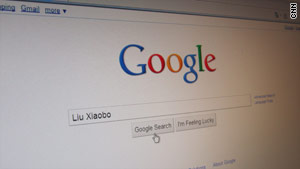
Chinese Government Cracks Down Liu Xiaobo's supporters

Liu Xiaobo, the 2010 recipient of the Nobel Peace Prize,  was in prison at the time of his award but supporters of his that somehow found out about his victory despite the government censoring all mentions of his name or the Nobel Peace Prize  have been arrested, placed under house arrest, and otherwise suffer from constant surveillance and limited access to communication resources according to Freedom House.

The censorship of Liu Xiaobo and the Nobel Peace Prize goes beyond removing the search results from a search engine like Google.com or Altavista.com but rather even text messages or twitter tweets that contain the phrases are heavily monitored and removed.

Here in the US we say the internet is the first amendment personified but here we have a authoritarian state limiting the spread of ideas and knowledge through the same tool, by omitting information.

I'd think that some of the more savvy individuals that support Liu Xiaobo can access information online through the use of proxy servers and ways to break the Great Chinese Firewall, but I am unsure how effective these are if we are hearing about harassment and arrests. This also goes to show how important anonymity online can be in an oppressive environment.

For more information about this development please read the CNN article and the Freedom House entry linked
________________________________________________________________________
From CNN: http://articles.cnn.com/2010-10-08/world/china.internet_1_great-firewall-china-proxy-servers?_s=PM:WORLD
____________________________________________
Freedom House Article: http://www.freedomhouse.org/template.cfm?page=599
* China Human Rights Defenders 1/18/2011: Rights defender enters fourth month of soft detention <http://chrdnet.org/2011/01/19/china-human-rights-briefing-january11-18>
* Boxun News 1/18/2011 (In Chinese): Netizen under house arrest since Nobel announcement <http://news.boxun.com/news/gb/china/2011/01/201101181206.shtml>
###